
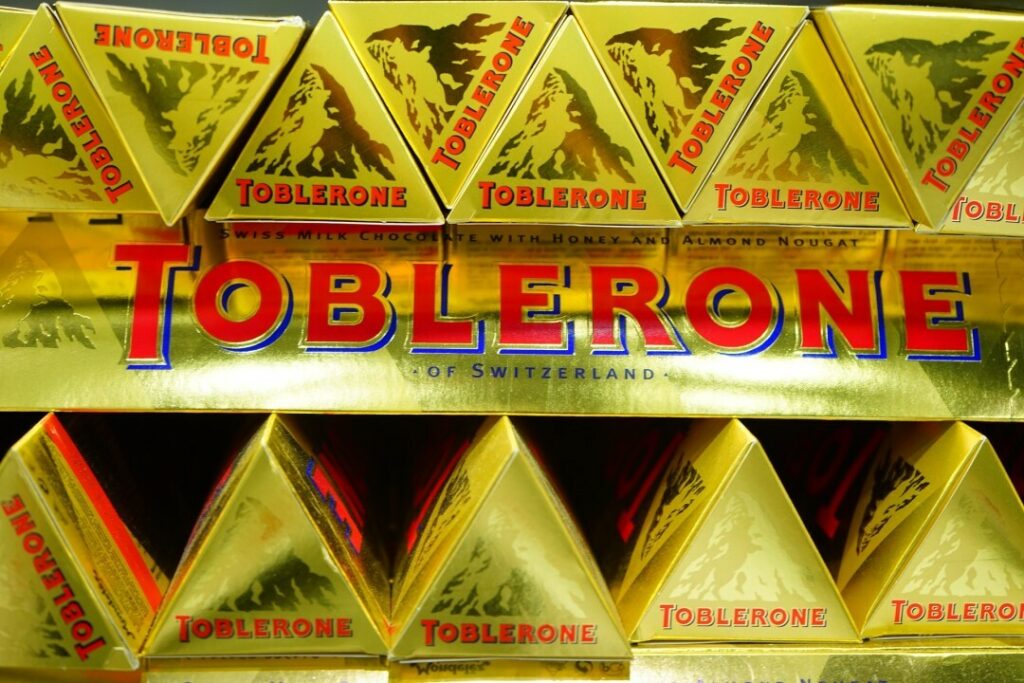
How did TOBLERONE conquer the world?
- In 1908. Theodor Tobler and Emil Baumann created a chocolate with a unique triangular shape inspired by the Matterhorn mountains in Switzerland. Each chocolate bar is shaped like a triangular prism. And the chocolate’s name is a combination of Theodor Tobler’s surname and the Italian word “torone”.
- You have probably guessed that we are talking about one of the most favourite chocolates – TOBLERONE.
- The TOBLERONE shape is one of the most famous three-dimensional trademarks, which is protected in many countries around the world.
- Its unique triangular shape distinguishes it from other products on the market and contributes to its identity. We all know TOBLERONE precisely because of the unique shape of the chocolate and the packaging of the product, which is easily recognisable among the variety in the shops.
- What is a three-dimensional brand?
- Pursuant to Article 9(1) of the Trademark Law, a trademark is a sign that is capable of distinguishing the goods or services of one person from those of other persons and may be represented in the State Register of Trademarks in a manner that allows the subject matter of the protection conferred by the registration to be clearly and precisely identified. Such signs may be, for example: words, including the names of persons, letters, figures, numbers, drawings, shapes, the form of the goods or of their packaging, colours, sounds or any combination of such signs.
- From the interpretation of this legal definition it can be concluded that a three-dimensional mark consists of a three-dimensional object – the shape of the goods or their packaging. The shape of the product or its packaging does not only play a functional role, but is a powerful marketing tool that helps to build an emotional connection with consumers. How often have you seen the shape of a product or its packaging evoke an aesthetic feeling?
- Pursuant to Article 11, paragraph 1, item 2 of the MGOA, a trademark that is not distinctive shall not be registered. Overcoming this limitation is considerably more difficult for three-dimensional marks than for word or combination marks, since consumers do not perceive a classic logo or word name in the same way from the shape of the goods or their packaging.
- We recognise our favourite products by their logo, which is a combination of an image and a word element, or just by the brand name that is written on the product label. This is how we choose wine, cheese or fish products. The shape of a product or its packaging rarely gives the impression of aesthetics and innovation and therefore rarely ‘catches’ the consumer’s eye.
We all know the Coca Cola bottle well. It has a curved shape that makes it easily recognisable. The Coca Cola bottle is also a three-dimensional brand because it is distinctive.
The foregoing leads to the conclusion that distinctiveness in three-dimensional marks requires that the shape of the goods or their packaging be different from the usual shapes of products in the relevant category. Secondly, the shape of the goods or their packaging must not be necessary for the performance of the product’s function. An ordinary bottle or functionally necessary packaging of a product will not obtain protection. The distinctiveness requirements of the Intellectual Property Offices in the EU are extremely strict, quite often requiring applicants to provide evidence of acquired distinctiveness of the applied-for three-dimensional mark.
Proving acquired distinctiveness requires collecting and presenting evidence of use and recognition of the mark. Investing in marketing, as well as in high-quality products that create brand loyalty, helps to build that all-important link between the form of the product or its packaging and consumers.